Overtime account with a time off agreement
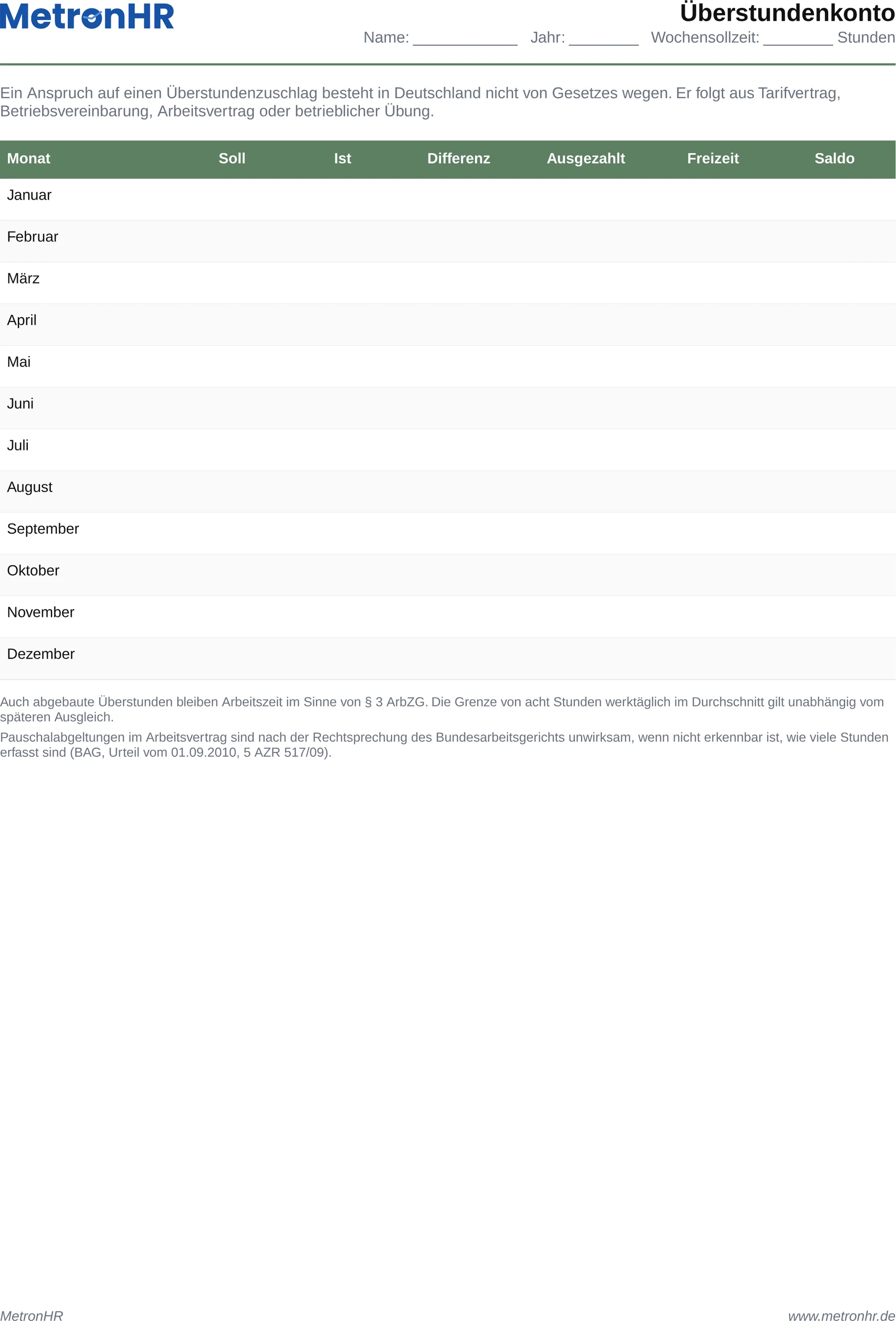
One annual sheet for target, actual, payout, time off in lieu and the running balance, plus a sample agreement on reducing the balance.
- Twelve monthly rows with target, actual and difference
- Separate columns for payout and time off in lieu
- A running balance that carries the previous month forward
- A notes column for agreements
What is in the template?
Ready to use, with formulas, sample data and a legend.
- Twelve monthly rows with target, actual and difference
- Separate columns for payout and time off in lieu
- A running balance that carries the previous month forward
- A notes column for agreements
- A sample agreement on reducing the balance as a separate PDF
When does the template fit?
Ideal as an interim solution or for small teams, with clear limits.
- An annual overview per employee for the review meeting
- A basis for deciding between payout and time off
- Documentation for payroll
The balance is only right if nobody maintains it by hand.
An overtime account in Excel is, at the end of the month, only as good as the person feeding it. MetronHR carries the balance forward from the recorded times, books payouts and time off in lieu as transactions and shows both sides the same position, with no need to ask.
In comparison
Excel template
Manual upkeep • no workflows • no reminders • copy anew for every employee
MetronHR
Automatic calculations • approval workflow • reminders • one central source for the whole team
Frequently asked questions
Answers on usage and legal aspects.
No. In Germany there is no statutory entitlement to a premium for overtime. It arises only from a collective agreement, works agreement, employment contract or established practice. 25 to 50 per cent is usual. To be distinguished from that are the tax-free premiums for night, Sunday and public holiday work under section 3b EStG, which have a different basis.
In that blanket form no, under the case law of the Federal Labour Court. A settlement clause is ineffective if employees cannot tell what service they owe for their salary (Federal Labour Court, judgment of 1 September 2010, 5 AZR 517/09). A clause naming a specific number of hours can be effective.
Where an effective limitation period exists, often three months from when the claim falls due, set out in the employment or collective agreement. Without one, the standard limitation period of three years to the end of the year applies. A claim requires that the overtime was ordered, approved or tolerated; in a dispute the employee has to show that.
For the limits of the Working Time Act yes. Section 3 ArbZG limits daily working time regardless of whether it is compensated later. The compensation period of six calendar months or 24 weeks only concerns whether exceeding eight hours up to ten was permitted.
Question not answered here? Every step is explained in the help centre.
Templates are a start. MetronHR is the answer.
When Excel reaches its limits in a team, MetronHR takes over the process. Try it free for 14 days.
Ready in 5 minutes, no credit card