Working time record under section 17 MiLoG
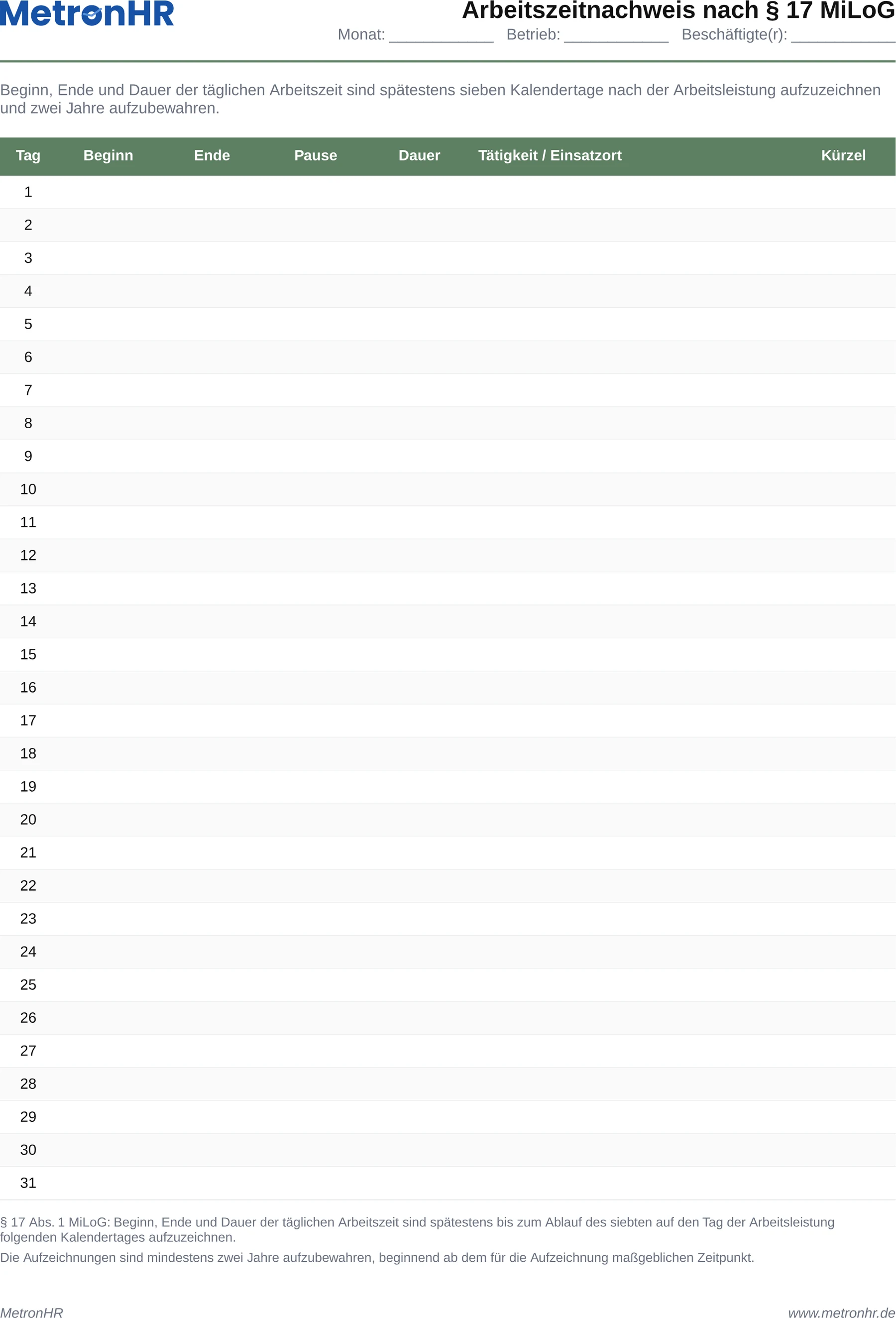
The start, end and duration of daily working time, recorded in the form section 17 MiLoG requires: no later than seven calendar days after the work was done, kept for two years.
- Twelve monthly sheets for 2026, with nationwide public holidays marked
- Duration per day calculated automatically from start, end and break
- A monthly total at the end of the sheet and a signature line for both sides
- Fields for the business, the employee, the activity and the place of work
What is in the template?
Ready to use, with formulas, sample data and a legend.
- Twelve monthly sheets for 2026, with nationwide public holidays marked
- Duration per day calculated automatically from start, end and break
- A monthly total at the end of the sheet and a signature line for both sides
- Fields for the business, the employee, the activity and the place of work
- Legal notes on the deadline and retention right on the sheet
When does the template fit?
Ideal as an interim solution or for small teams, with clear limits.
- Businesses in the industries named in section 2a of the Act to Combat Undeclared Work
- Marginally employed staff, for whom section 17 MiLoG applies regardless of industry
- Evidence for the customs financial control unit
A spreadsheet does not prove who changed it and when.
The record under section 17 MiLoG has to stand up in an inspection. An Excel file can be changed retroactively without anyone seeing it. MetronHR records the time when you clock in, checks it immediately against the limits of the Working Time Act and keeps every correction with the person, the timestamp and the old value.
In comparison
Excel template
Manual upkeep • no workflows • no reminders • copy anew for every employee
MetronHR
Automatic calculations • approval workflow • reminders • one central source for the whole team
Frequently asked questions
Answers on usage and legal aspects.
To marginally employed staff and to all employees in the economic sectors named in section 2a of the Act to Combat Undeclared Work. Those include construction, hospitality and accommodation, passenger transport, freight forwarding, transport and logistics, the showman's trade, forestry, building cleaning, the assembly and dismantling of trade fairs and the meat industry.
No later than the end of the seventh calendar day following the day the work was done (section 17 (1) MiLoG). So it is not enough to enter everything at the end of the month.
At least two years, starting from the point relevant for the record (section 17 (1) sentence 2 MiLoG). Tax and commercial law periods can be longer.
Not the duty under section 17 MiLoG, but the general duty to record working time does. On 13 September 2022 the Federal Labour Court decided (1 ABR 22/21) that employers must introduce a system for recording working time; that follows from section 3 (2) no. 1 of the Occupational Safety Act.
The signature documents acknowledgement and is customary, but it is not required by law. What matters is that the start, end and duration are recorded and that the record was created on time.
Question not answered here? Every step is explained in the help centre.
Templates are a start. MetronHR is the answer.
When Excel reaches its limits in a team, MetronHR takes over the process. Try it free for 14 days.
Ready in 5 minutes, no credit card